Merino Wool vs Ordinary Wool: After Reading This, You’ll Never Choose the Wrong Knit Fabric Again
As an enthusiast who has long focused on knitted apparel, especially the fabrics used for knit beanies, I am often asked,“What exactly is the difference between merino wool and regular wool?”“Since both are wool, why the price difference of several times?”The core distinction lies not in whether it's “wool or not,”but in fiber texture, performance, and suitability for different scenarios. Choosing correctly saves money and ensures comfort, while making the wrong choice leads to either an uncomfortable fit or quick deformation after just a few wears. Today, I'll explain the differences in the most straightforward way, ensuring you can avoid pitfalls accurately—whether buying knit caps, sweaters, or scarves.
Quick Comparison of Differences
| Comparison Dimension | Merino Wool | Regular Wool |
| Fiber Fineness | Ultra fine (17-22μm), close to cashmere | Coarser (25-40μm), stiff fiber |
| Skin-friendliness | Soft and smooth, skin-friendly for direct contact, no itching | Rough and stiff, easy to irritate skin, need inner layer |
| Warmth & Breathability | Constant temperature performance, warm, breathable and moisture-wicking, no stuffiness | Moderate warmth, poor breathability, easy to feel hot and sticky |
| Elasticity & Deformation | Good resilience, not easy to collapse or deform, keeps shape after long wear | Average elasticity, prone to sagging and collapsing, out of shape easily |
| Antibacterial & Odor Resistance | Naturally antibacterial, odor-resistant after sweating, easy maintenance | Absorbs sweat easily, breeds bacteria, prone to odor, requires frequent washing |
| Price Positioning | High cost, high-end grade, ideal for premium apparel | Affordable price, mid-low grade, suitable for basic & mass production styles |
| Application Scenarios | Beanies, close-fit sweaters, high-end scarves, outdoor clothing | Coarse knit sweaters, lining fabric, entry-level knit accessories |
1. Fiber Fineness: The Key to Itch-Free Wearing
This is the most essential difference between merino wool and regular wool, and also the core factor of skin-friendliness that people care about most.
Many people think it is normal for wool to feel itchy. In fact, the root cause lies in fiber thickness — and merino wool perfectly solves this pain point. Its fineness is not only reflected in touch, but also suitable for sensitive skin, infants and other special groups. Even worn directly against the skin as a beanie, long-time contact with cheeks and neck brings no discomfort.
Fabrics woven from such fine fibers are resistant to pilling and fuzzing, maintaining a neat premium feel after long-term wear without looking worn out after just a few uses.
Besides skin irritation, the stiffness of regular wool brings another hidden problem: the fabric easily pills, fuzzes and loses shape. Especially for frequently worn and friction-prone accessories like beanies, the surface will fuzz up and the edges will turn loose after wearing several times.
The rough scale arrangement of regular wool also makes it easy to absorb dust and lint, requiring frequent cleaning; otherwise it looks messy and untidy.
Practical tip: When buying a beanie, gently rub the fabric. If it feels soft and fluffy without stinging, it is most likely merino wool. If it feels rough and coarse with obvious hard texture, it is usually regular wool.
2. Warmth & Breathability: Constant Temperature Champion vs Stuffiness Type
Though both are wool, the gap in warmth and breathability directly determines wearing experience. Especially in autumn and winter, beanies and sweaters need to keep warm without making you sweat and feel stuffy.
Merino wool’s constant temperature and breathable advantages are prominent in changeable autumn and winter weather. It quickly adapts to temperature differences between indoor and outdoor, avoiding the awkwardness of feeling stuffy indoors yet not warm enough outdoors.
Its excellent sweat absorption and moisture-wicking performance reduce sweat residue, bringing better comfort, extending garment service life and lowering washing frequency. What’s more practical is that merino wool fabric dries quickly when accidentally splashed with water or stained, leaving no water marks, making daily maintenance effortless.
The stuffiness of regular wool becomes obvious when wearing beanies or thick sweaters for a long time, especially during exercise and commuting. Trapped sweat causes stickiness and discomfort, and easily breeds bacteria and odor.
Regular wool relies on thickness for warmth. To reach the same warmth as merino wool, it becomes much heavier and bulky, greatly reducing comfort and being unsuitable for matching slim-fit outfits.
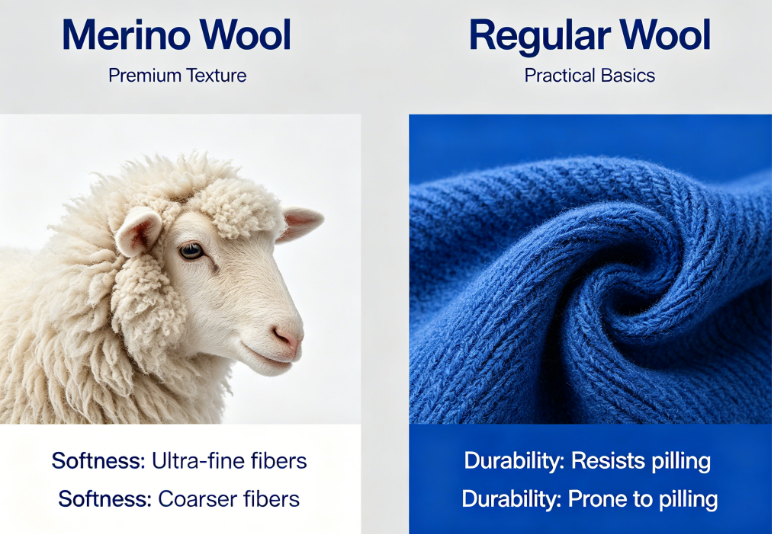
3. Texture & Durability: Premium Texture vs Basic Practicality
In terms of appearance and durability, the two are completely positioned for different needs and budgets.
Merino wool features a premium texture beyond its smooth fine surface — it also performs excellently in dyeing. Fine fibers absorb dye better, presenting even, rich color that resists fading and color bleeding. It keeps its original shade even after multiple washes, perfect for premium-colored beanies and sweaters.
Note that merino wool is delicate: wash with cold water and mild detergent, lay flat to dry, avoid strong sunlight and machine spinning, otherwise it will shrink and deform.
Regular wool shines in cost performance and practicality. It is affordable and low-maintenance, hardly damaged by machine washing or sun exposure, ideal for basic and fast-fashion styles.
However, it has poor dyeing performance with dull, uneven color, prone to fading and color bleeding. After long-term wear, the fabric turns rougher and looser with declining overall texture, more suitable for short-term wear and frequent replacement.
4. Application Scenarios: Match Properly, Avoid Wasting Money
Finally, we summarize their applicable scenarios to help you make a quick choice:
Choose Merino WoolPerfect for skin-contact items like beanies and close-fitting sweaters. Ideal for people with sensitive skin, those pursuing dressing texture, or anyone valuing long-term comfort. It is also great for outdoor enthusiasts — lightweight, warm and breathable, adaptable to various outdoor scenarios, durable and able to keep its shape and texture for years.
Choose Regular WoolSuitable for budget scenarios where skin-friendliness is not a priority, such as outer coarse-knit sweaters, coat lining, and basic knit accessories for the elderly and kids. It is for occasional wear and easy replacement, low in cost and maintenance, enough to meet basic warmth needs.
There is actually no "better" wool—only a more suitable choice.Merino wool excels in fineness, skin-friendliness and premium grade, yet it comes with a higher price.Regular wool may lack luxurious texture, but it offers great cost performance and easy care.
If you’re buying skin-touch accessories such as beanies, I truly recommend prioritizing merino wool. After all, you wear it on your head every day, and comfort always comes first.If you only need a basic sweater for occasional wear, regular wool is more than enough.
Next time you shop for wool apparel, refer to this guide. You’ll never be misled by the simple word "wool" again, and you can always pick the fabric that fits you perfectly.