Embroidery vs woven patch for custom Beanies
Custom knitted beanie is a popular product in foreign trade. During the customization process, logos and patterns best reflect the product's quality and enhance brand recognition. Embroidery and woven patches are the two most commonly used techniques in knitted beanie customization. Embroidery offers greater three-dimensional texture, while woven patches provide clearer and more delicate details, leaving many buyers in a dilemma when making choices. This article concisely breaks down the core features of both techniques, compares their differences through charts, and helps you quickly select the right solution.
Core Introduction of the Two Crafts
Embroidery — Three-dimensional & Textured
Embroidery involves stitching thread directly onto the Beanie fabric through the density and direction of stitches. Overlapping stitches create a distinct three-dimensional texture with strong depth, delivering a plush tactile feel that appears sophisticated and refined. It is well-suited for minimalist brand logos, text, and simple lines. If the hat's texture is a priority—such as for custom high-end gift hats—embroidery is an excellent choice. However, its limitation lies in being constrained by the complexity of the design, as intricate lines or multiple colors can increase production difficulty and costs.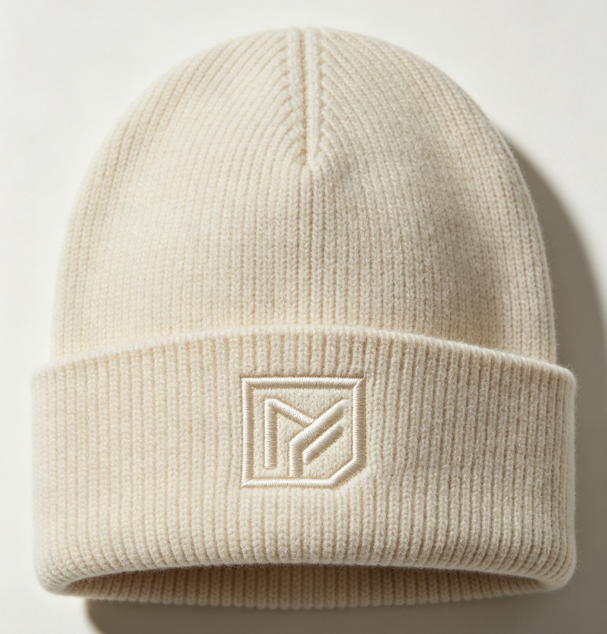
Woven Patch — Exquisite & Perfect for Complex Patterns
The woven patch is first printed with the design on a dedicated fabric using a loom, creating an independent patch piece, which is then sewn or heat-sealed onto the beanie surface. Its core advantages include high fineness, precise reproduction of intricate patterns, fine text, and gradient colors, along with strong flexibility that allows for pre-production batch-making of patches to meet the needs of multiple style switches, such as IP collaborations or multi-color logo customizations. The main drawbacks are relatively weak three-dimensional effects and more complex processes compared to embroidery, resulting in slightly higher costs for small-scale customizations.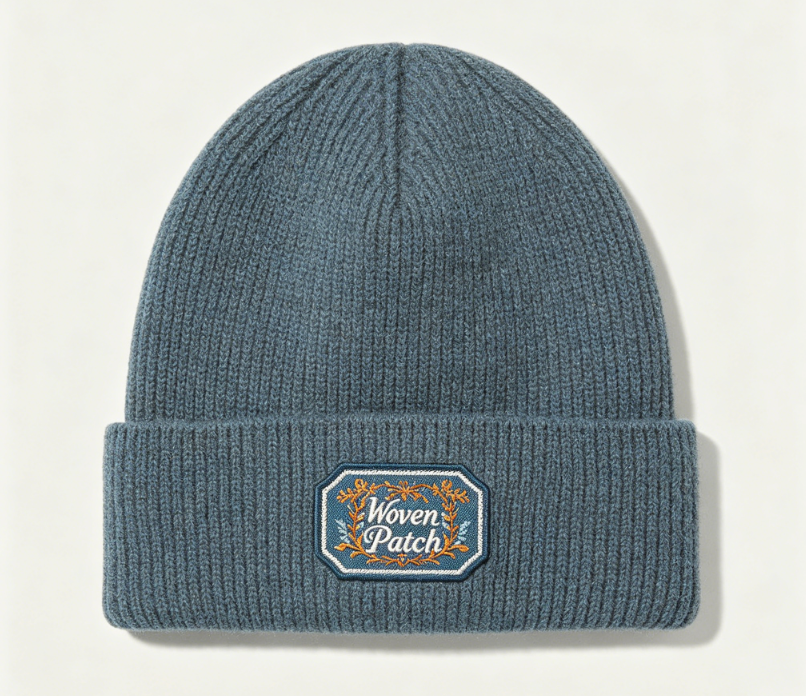
Chart Comparison of Core Differences Between the Two Processes
| Comparison Dimension | Embroidery | Woven Patch |
| Core Texture | Three-dimensional & full, embossed texture, thick hand feel | Flat and delicate, no concave-convex texture, smooth hand feel |
| Pattern Adaptability | Suitable for simple designs, not for complex patterns | Perfect for complex patterns with ultra-high restoration |
| Production Cost | Low cost for small-batch customization, no extra process fee | High cost for small-batch customization, extra fixed charge required |
| Application Scenarios | Brand LOGO, corporate customization, high-end gifts | IP co-branding, complex patterns, multi-style customization |
Choose accordingly for higher efficiency
There is no superiority or inferiority between the two processes, just fit the requirements:
If you are pursuing texture, customizing simple logos, and have a large batch size (500 pieces or more), embroidery craftsmanship is preferred. It has low cost, high efficiency, highlights the brand's high-end sense, and is suitable for foreign trade wholesale and enterprise customization.
If your pattern is complex and there are many colors, machine woven patches are preferred for high fidelity and flexibility, suitable for IP co branding and trendy item customization.